« Part 1
NFCA continues its exploration of the skin conditions that may be causing you pain and irritation. Part 1 covered the hallmark celiac skin condition, dermatitis herpetiformis (DH). Part 2 discusses two other prominent skin disorders: psoriasis and eczema.
Celiac & Skin: Part 2
Psoriasis
Psoriasis is a non-transmittable, chronic, inflammatory disorder affecting the skin, caused by an accelerated rate of skin cell growth in the body.
Psoriasis can appear at any age; however, it’s most often seen in patients 15-35 years old - 10-15% of cases develop before the age of 10. Men and women are affected equally.
Like celiac disease, psoriasis is an autoimmune condition. And, although the causes, triggers, and mechanisms of both conditions are still largely unknown, genetics have been identified to play a role in their development.
Psoriasis is also associated with other more serious health conditions, such as diabetes, heart disease and depression.
What does it look like?
There are five types of psoriasis, each with their own distinct set of characteristics:
-
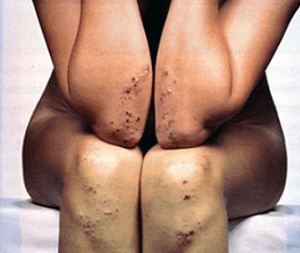
Plaque psoriasis: Comprises about 80% of all psoriasis cases, and appears as raised red patches or lesions covered with a silvery white scale (buildup of dead skin cells). Plaque psoriasis can occur on any part of the body, although areas such as elbows, knees, scalp and lower back are most common.
-
Guttate psoriasis: Most often appears in children and young adults, although about 10% of individuals with psoriasis will develop this type. Guttate presents as small, individual red spots or lesions, typically on the trunk or extremities.
-
Inverse psoriasis: Affects ‘folding’ areas of the body, such as the armpit, groin, buttocks, and areas under the breast and genitals. Because of this, tenderness and irritation caused by sweating and rubbing can result. This type of psoriasis appears as bright, shiny, smooth read patches or lesions.
-
Pustular psoriasis: Presents as white, scaling pustules (blisters) surrounded by red skin. This type occurs more frequently in adults, and can be generalized, covering large areas of the body, or relegated to specific areas such as hands and feet.
-
Erythrodermic psoriasis: The rarest form of psoriasis, appearing in only 1-2% of patients, often only once in a lifetime. Classified by generalized redness and scaling in sheets, similar to the look of a burn, patients with this type may experience severe itching, pain, as well as fluctuating heart rate and body temperature.
While people can have more than one type of psoriasis, generally only one form will appear at a particular time. Psoriasis can also occur independently or in conjunction with other skin conditions, such as dermatitis herpetiformis (DH) and eczema.
Diagnosis & Treatment
There are no specific tools, procedures, cures or prescriptions used to diagnose and treat psoriasis. A doctor will normally recommend topical treatments ranging from prescription corticosteroids to Vaseline.
While research is ongoing, a gluten-free diet has not been proven successful in treating psoriasis itself.
References:
-
Blumer, Ian, MD, Crowe, Shelia, MD. Celiac Disease for Dummies. Wiley & Sons, 2010.
-
Green, Peter H.R, Jones, R. Celiac Disease: A Hidden Epidemic. HarperCollins, NY, 2010
-
National Psoriasis Foundation, www.psoriasis.org.
Eczema
Atopic dermatitis (AD), the most common type of eczema, is another skin condition that’s been found to occur more frequently in those with celiac. According to research, individuals with celiac disease are three times as likely to suffer from eczema, which affects close to 30 million Americans.
Much like psoriasis, AD is a non-transmittable, chronic condition that affects both men and women equally. Although AD can appear at any age, about 90% of patients first present with the condition before the age of 5.
What does it look like?
Dry, red, itchy, cracked skin is the hallmark sign of AD. Oozing or weeping skin and crusted sores can also develop, frequently when skin is infected or scratched.
While AD can affect any part of the body, it typically appears on the elbows, knees, face, hands and feet.
What causes AD/Eczema?
While the exact cause remains a mystery, scientists believe an overactive immune response to unknown triggers plays a role in the development of AD.
Genetics as well as certain environmental triggers are also thought to be a factor.
Family members of AD and/or celiac disease patients are known to be at an increased risk. In fact, the risk of having AD doubles in individuals with celiac family members, whether or not they also have the disease. Eczema can also run in families with a history of allergies, asthma, and hay fever – indicating another genetic link.
Meanwhile, AD “flare-ups” can result from certain environmental triggers. Prolonged exposure to heat or cold, contact with allergens or irritants such as certain materials, detergents, or personal care products – even colds, viruses, infections and stress can cause AD to reappear.
How is it diagnosed?
A primary care physician, allergist or dermatologist can diagnose AD with relative ease and accuracy. However, subsequent testing for additional allergies that could potentially cause subsequent flare-ups may be recommended.
Eczema can occur independently or along with DH and/or psoriasis. As a result, patients with undiagnosed celiac disease can often be misdiagnosed with eczema alone.
Treatment
Although there is a known cure or treatment for eczema, a variety of therapeutic options can be employed to alleviate symptoms.
Proper skin care can greatly reduce the need for any prescription treatment. Healthy home care practices frequently include keeping skin well hydrated and moisturized, and avoiding any known or potential irritants, including fabrics, detergents, soaps, dyes, and anything that causes an extreme change in temperature or stress levels. Patients are also advised to prevent scrubbing or scratching skin, as it can aggravate eczema symptoms.
If severe, an oral antihistamine or topical corticosteroids may be prescribed.
Some children with AD have been known to outgrow the condition, although many individuals experience flare-ups periodically throughout their lifetimes.
Although research is limited, there are studies that show that a gluten-free diet can help to treat eczema in some patients.
Sources:
-
Green, Peter H.R, Jones, R. Celiac Disease: A Hidden Epidemic. HarperCollins, NY, 2010
-
Blumer, Ian, MD, Crowe, Shelia, MD. Celiac Disease for Dummies. Wiley & Sons, 2010.
-
National Institutes of Health. Atopic Eczema. http://health.nih.gov/topic/Eczema.Updated 10/10/2010.
-
E. Varjonen. Antigliadin IgE - indicator of wheat allergy in atopic dermatotis. Allergy. 2000 Apr;55(4):386-91.
-
B.T. Cooper et al. Coeliac disease and immunological disorders. British Medical Journal. 1978, 1, 537-539.
-
C. Ciacci et al. Allergy prevalence in adult celiac disease. Journal of Allergy and Clinical Immunology. 2004 jun;113(6):1199-203.